Pages

Showing posts with label labor force participation. Show all posts

Wednesday, August 5, 2020

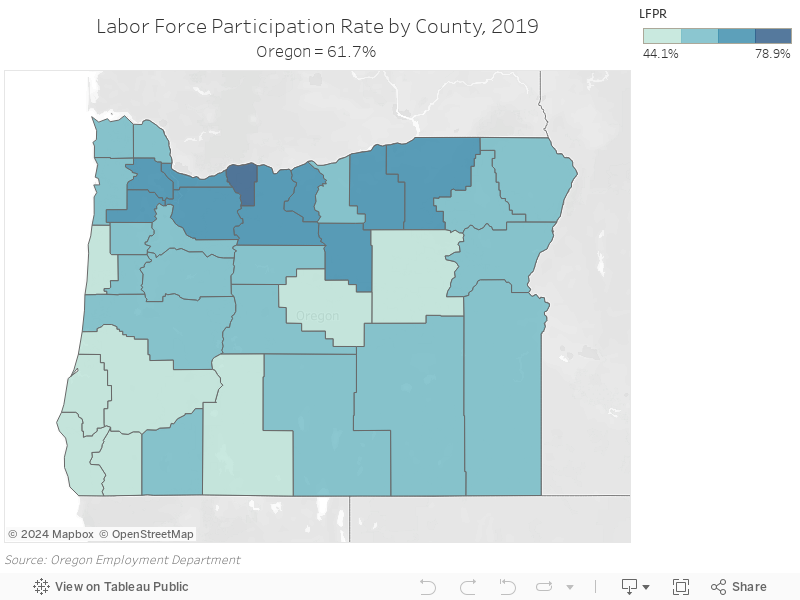
Oregon Labor Force Participation Rates by County, 2019

Labor force participation rates for Oregon’s counties in 2019 ranged from a high in Hood River County of 78.9 percent to a low in Curry County of 44.1 percent.

Generally, counties located in the Northern part of Oregon, and especially in the Columbia River Gorge, had higher LFPRs in 2019. Counties located along the coast, and in the Southern and Eastern parts of Oregon generally had lower LFPRs.

One factor associated with a county’s LFPR is the age composition of the population in that county. LFPRs vary by age group. People age 65 years and over have the lowest LFPRs of all age groups (19.3% in Oregon for 2019), as many individuals in this category are retired. Generally, Oregon counties that have a higher percentage of the population age 65 years and over tend to have lower labor force participation rates. The counties with the lowest LFPRs in Oregon tend to have higher percentages of the population that are age 65 years and over relative to other counties in Oregon – Curry County (35.0%), Crook County (25.2%), and Coos County (26.5%). On the other hand, the counties with the highest LFPRs all have low percentages of the population that are age 65 years and over – Hood River County (16.3%), Washington County (13.9%), and Multnomah County (13.9%).

Those in the age range of 16 to 24 years have a lower LFPR than the overall average; nearly 3.0 percentage points lower than the statewide average in Oregon in 2019. The counties in Oregon with the highest percentage of the population between the ages of 15 to 24 in 2019 – Benton County (25.8%), Polk County (16.3%), Lane County (15.6%), and Union County (14.9%) – are each home to a sizable university relative to the overall county population. As the presence of a university boosts an area’s population in this age range, the result is downward pressure on the LFPR since this age group tends to participate less in the labor force due to school attendance and related activities. The counties mentioned above all have LFPRs that were lower than the statewide average in 2019.

To learn more about Labor Force Participation Rates by County, read Local Area Unemployment Statistics Coordinator Tracy Morrissette's full article here

Friday, June 19, 2020

In Honor of Juneteenth: Black Oregonians in the Labor Force

This Friday June 19, celebrate freedom by celebrating Juneteenth! Short for “June Nineteenth,” Juneteenth commemorates the 1865 arrival of federal troops in Galveston, Texas, to ensure that all enslaved people be freed. Their arrival was over two years after the signing of the Emancipation Proclamation. Juneteenth is considered the longest-running African-American holiday (read more at History.com). In honor of Juneteenth, here are some facts about Oregon's Black population and laborforce.

According to U.S. Census Bureau’s 2018 American Community Survey estimates, there are about 116,586 residents of Oregon who identify as Black or African American alone or in combination with another race, or about 3 percent of Oregon’s population. According to The Oregon Encyclopedia, Oregon's racial makeup has been shaped by three black exclusion laws that were in place during much of the region's early history. These laws, all later rescinded, largely succeeded in their aim of discouraging free blacks from settling in Oregon early on, ensuring that Oregon would develop as primarily white.

Black Oregonians in the Labor Force
There are roughly 60,000 Oregonians age 16 years or older who identified as Black alone in 2018. Black Oregonians have higher rates of labor force participation (65.2%) than all Oregonians (62.2%) but also a higher rates of unemployment at 10.8 percent compared to 6.0 percent for all Oregonians.

Though only a small share of Oregon's workforce (2%) identifies as Black or African American, the number of Black workers has grown rapidly over the past 20 years. From 1999 to 2019, the number of Black workers has grown by 85 percent, from 28,773 in 1999 to 53,210 in 2019, according to the U.S. Census Quarterly Workforce Indicators data. This is a much faster growth rate than for the Oregon workforce overall (23%).
More than half of Black workers statewide are employed in one of three sectors: educational services, health care, and social assistance (28%); retail trade (12%); or manufacturing (11%).
Another one-fourth of Oregon’s African Americans work in arts, entertainment, accommodation and food services (11%); professional, scientific, management, administrative, and waste management services (7%); or transportation, warehousing, and utilities (7%). The remaining balance are spread across other sectors.

African Americans have the third highest average monthly earnings in the state at $3,786 or 84 percent of the 2018 statewide average ($4,518). Asian residents had the highest average monthly earnings at $5,589, followed by white residents at $4,528. Native Hawaiian or Other Pacific Islanders ($3,382), and American Indian or Alaska Natives ($3,247) had the lowest monthly earnings statewide.

To learn more about Black Oregonians in the labor force, check out the following articles:
African Americans in the Oregon Workforce

Friday, November 22, 2019

Working Over Time: Workers 65 and Older in Oregon

In the last few decades, the number of people who work later than the “traditional retirement age” of 65 has grown substantially. In fact, the population of workers in their 60s and 70s has been the fastest growing segment of the labor force in the last 10 years.


The number of workers 65 and older in Oregon has more than quadrupled since 1992. People 65 and older now make up nearly 7 percent of all workers, up from 2 percent 25 years ago.

While it’s true our population is getting older overall with the aging of the large baby boomer generation, the rate at which older people participate in the labor force is increasing as well, from a low of about 10 percent in the mid-90s to nearly 20 percent in recent years. That means about one out of five people 65 and older have a job or are unemployed and looking for work.

This trend is likely to continue: the Bureau of Labor Statistics projects that nationally, the over-65 population is the only age group that will see a substantial increase in their workforce participation rates from 2018 to 2028.


Choice or Necessity?

Is an increase in older workers a cause for celebration or alarm? As is the case with so many economic questions, the best answer is probably, it depends.

Some people are working longer because they can. As Americans stay healthy and live longer, many see no reason to stop doing work they enjoy, especially since many jobs are less physically taxing than they used to be.

Another explanation is that people continue to work past 65 out of economic necessity. Fixed retirement income may not be enough to cover costs. Nationally, people in the bottom half of the income distribution are likely not to have any retirement savings, with Social Security often replacing only about 40 to 50 percent of pre-retirement income. Increasing housing and health care costs in many areas of Oregon are likely to create money pressures among the aging population that could keep them in the labor market.

Structural changes in retirement policies interact with these individual circumstances as well. Increases in labor force participation for older Americans coincide with increases in the minimum retirement age for full Social Security benefits. There has also been a large-scale shift by businesses from defined benefit to defined contribution retirement plans for their employees, which shift the risk of retirement investments from employers to workers.

To learn more, read workforce analyst Henry Field's full article here.

Friday, November 8, 2019

Employment Among Oregon's Veteran's

In 2018, the unemployment rate for veterans in Oregon was 4.8 percent, according to the Current Population Survey. Overall, Oregon’s unemployment rate was 4.2 percent in 2018. Across the U.S., veterans had a lower unemployment rate of 3.5 percent.

About 296,000 veterans lived in Oregon in 2018. More than half of veterans (162,000) were not in the labor force. This figure could be related to the age of veterans. According to the American Community Survey, more than half of Oregon’s veterans were age 65 years or older and served in the military at least four decades ago: Vietnam War (110,596 veterans), Korean War (20,634), and World War II (7,852). Gulf-War I and II veterans totaled 94,463.

Around 128,000 of the 134,000 veterans in the labor force were employed, with 105,000 being employed full time and 22,000 part time. About 6,000 veterans were unemployed, which accounted for 7.3 percent of the unemployed population (82,000) in the state. Over the last two decades, unemployed veterans made up between 6.9 percent and 14.6 percent of the overall unemployed population in Oregon.

Veterans are employed across all industries. In the United States, manufacturing (11.7% of veterans); professional and business services (11.4%); retail trade (8.4%); and education and health services (8.4%) are industries where a large number of veterans are employed. About 21.7 percent of veterans work in government.

In 2018, Oregon’s veterans earned a higher median income ($40,012) than nonveterans ($30,979). Education could be one of the factors influencing veterans’ higher median income. Among Oregon veterans ages 25 years and older, 42.6 percent have an associate’s degree or some college compared with 33.5 percent of nonveterans. About 5.4 percent of veterans don’t have a high school diploma, while 9.9 percent of nonveterans don’t have a high school diploma. Higher educational attainment generally translates into higher earnings.

Female veterans, who represented 8.9 percent of Oregon’s veterans, earned a median income of $35,832, less than male veterans’ median of $40,485, but higher than female nonveterans’ income of $25,780.


Veterans are more likely to have a disability, but less likely to be in poverty than the general population. About 33.3 percent of Oregon’s veterans reported having disability, compared with 15.0 percent of the total civilian population. About 7.2 percent of veterans were in poverty compared with about 12.1 percent of the total civilian population.

To learn more, read Economist Sarah Cunningham's full article here.

Friday, October 18, 2019

Differences in Workers' Employment, Education and Industry by Ethnicity

According to the 2013-2017 five-year ACS estimates (the most current available), Oregon had roughly 2.1 million people between the ages of 25 and 64. Of them, 236,000 were of Hispanic or Latino origin, while the state’s non-Hispanic population in the same prime working age range totaled 1.9 million. The non-Hispanic population includes Oregonians of any race (African-American, Asian, Native American, White, or any other race(s)) that did not self-identify as Hispanic or Latino.

Educational attainment differed widely between Hispanic and non-Hispanic prime working age populations. Almost two-thirds (63%) of the non-Hispanic population had some education beyond high school. Meanwhile, two-thirds (67%) of the Hispanic population had a high school diploma or less.


Labor Force Participation

Employment and labor force participation also varied notably between Hispanic and non-Hispanic populations. At all education levels, larger shares of the Hispanic prime working age population were in the labor force. The largest disparities occurred among those with less education. Nearly half (45%) of the non-Hispanic population with less than a high school degree sat out of the labor force, compared with 21 percent of Hispanic or Latino Oregonians in the same age group. Among those with at least some college education, shares of the population who were employed looked quite similar.

Education Pays

Hispanic and Latino workers ages 25 to 64 with a high school diploma or less were particularly concentrated in lower-wage industries. Annual wages for all jobs covered by Unemployment Insurance in Oregon averaged $52,400 in 2018. While roughly one-third (35%) of all non-Hispanic workers held jobs in sectors that paid below the all-industry average, nearly half (48%) of Hispanic workers did. As educational attainment increased, the distribution of industry employment looked similar by ethnicity.


Manufacturing and construction showed similar patterns for Hispanics and non-Hispanics. Comparable shares of both Hispanic and non-Hispanic prime-age workers across education categories held jobs in manufacturing. Larger shares of prime-age workers with a high school degree or less held jobs in construction compared with more educated workers.

Keep Learning for Higher Earnings

Overall, the portion of Oregonians ages 25 to 64 that participated in the labor force and held jobs increased along with educational attainment. Employed Oregonians with more education were also more likely to work in higher-wage industries. Larger shares of the Oregon’s Hispanic or Latino prime working age population had not earned a high school diploma. Hispanic and Latino workers were more concentrated in lower-paying industries. Additional data about the demographic and educational attainment characteristics of workers can be found on the IPUMS USA website, https://usa.ipums.org/usa/.

Read senior economic analyst Gail Krumenauer's full article here

Thursday, June 27, 2019

For Oregon Parents, Working Is the Norm

Oregon’s civilian labor force includes 697,000 parents of children under 18. Working parents account for one-third of the state labor force, a similar percentage to the nation (32%). Parents of children under six years of age make up 14 percent of the state workforce, and those with children ages six to 17 years account for another 19 percent.

Parents are more likely to be working than people without children under 18. The participation rate for the Oregon population with no children under 18 is 54.5 percent, compared with 84.0 percent of parents with children under 18. This likely reflects an aging population and an increasing number of retired people. Participation for teens and young adults has also been lower in recent years than in decades past.

Labor force participation of parents differs by gender and the age of children. For parents of children under six years of age, there’s a big difference in the labor force experiences of men versus women. Of the men in this group, 93.1 percent are in the labor force, compared with 67.0 percent of Oregon mothers of children under age six. Oregon fathers in this group are slightly less likely to be in the labor force than the national average, and Oregon mothers of children under age six are slightly more likely to be in the labor force than the national average.

The gender gap in labor force participation is reduced somewhat for parents of children ages six to 17. For men with children ages six to 17, the participation rate was 93.7 percent in 2018, and 83.3 percent of Oregon women with children in that age range were in the labor force. The participation rate of men with children ages six to 17 is slightly above the national rate (92.2%). Oregon women’s participation rate is nearly 7 percentage points above the national rate of 76.4 percent for women with children ages six to 17.

For people without children under 18, the genders behave far more similarly in their likelihood of labor force participation. Men in this group had a participation rate of 58.3 percent compared with the women’s participation rate of 50.7 percent.


To learn more, read employment economist Jessica Nelson's full article here.

Thursday, January 3, 2019

Oregon's Youth and Young Adult Labor Force Participation Trends

For more than two decades, the labor force participation rate (LFPR) - the percentage of the civilian non-institutionalized population that is either employed or unemployed - for Oregon's youth and young adult population has been on a general downward trend. The LFPR for people between the ages of 16 and 24 years dropped from a peak of 72.9 percent in 1996 to 54.2 in 2015, a considerable decline in workforce participation over that time period to the lowest annual percentage since comparable records began in 1978. Although the LFPR for this age group increased in 2016 to 54.9 percent and to 60.6 in 2017, the series remains at low levels relative to the years prior to 2000.

The LFPR for Oregon's youth (ages 16 to 19 years) declined more dramatically than for Oregon's young adults (ages 20 to 24 years). The LFPR for Oregon's young adults peaked in 1996 at 83.2 percent, and then generally declined to a record low of 71.0 percent in 2013. Having since increased to 74.4 percent in 2017, the LFPR for Oregon's young adults is higher than it was in 2013, although lower than it was two decades ago.

The LFPR for Oregon's youth peaked much earlier than for young adults, at 63.7 in 1989. Since reaching this peak in 1989, the LFPR for people ages 16 to 19 years has generally declined each year, falling by close to 30.0 percentage points from 1989 to a historical low of 33.5 percent in 2015. Like the LFPR for Oregon's young adults, the LFPR for ages 16 to 19 years has increased over the last few years to 40.4 percent in 2017. Despite the recent increase, the current LFPR remains well below the 1989 peak.


To learn more about the labor force participation rate of Oregon's youth and young adults, read the full article written by Local Area Unemployment Statistics Coordinator, Tracy Morrissette

Tuesday, September 18, 2018

Lowest on Record: Oregon Unemployment Rate Drops to 3.8 Percent in August

Oregon’s unemployment rate was 3.8 percent in August, the lowest rate since comparable records began in 1976. Oregon’s July unemployment rate was 3.9 percent. The U.S. unemployment rate was 3.9 percent in both July and August.

In August, the number of unemployed people dropped to 80,500, which is down from 88,000 in August 2017. The low number of unemployed reflects a very tight job market. Many people just entering the labor force are getting snapped up by employers. In August, there were only about 20,000 new entrants to the labor force who were unemployed; this was only one-third the number of such “unemployed entrants” seen in the early 2010s. This means that there are far fewer Oregonians entering the workforce who can’t find a job. Meanwhile in August, of the unemployed Oregonians, 28,000 had lost their job—a historically low level, given that in 2009 there were five times the number of unemployed due to job loss.

In August, Oregon’s nonfarm payroll employment grew by a modest 900 jobs, following a revised gain of 3,400 jobs in July. Monthly gains in August were concentrated in construction, which added 800 jobs, wholesale trade (+800 jobs), and retail trade (+700 jobs). These gains were offset by losses in leisure and hospitality (-1,100 jobs) and government (-600 jobs).


You can find more information about Oregon's current employment situation in the full press release.

Thursday, July 19, 2018

Oregon’s Youth Unemployment Rate at Record Low

Oregon’s unemployment rate was 4.1 percent in 2017, which was Oregon’s lowest unemployment rate since comparable records began in 1976.

The unemployment rate for Oregon teens ages 16 to 19 was 9.5 percent in 2017, which was also the lowest unemployment rate since 1978 when comparable records began. This was a large drop from a year before when the unemployment rate for teens was 20.0 percent.

The unemployment rate for Oregon young adults ages 20 to 24 was 7.6 percent in 2017, which was also the lowest unemployment rate recorded for this age category. The last time the unemployment rate for young adults was 7.6 percent was in 2005. In 2016, the unemployment rate for young adults was 9.6 percent.

Having a part-time or summer job used to be the normal situation for many teenagers. The labor force participation of teens averaged around 59 percent from 1978 to 2000. The rate started falling dramatically in 2001 both in Oregon and the nation. During the recession and in the aftermath of the recession it continued to slip.

Oregon’s strong job growth since 2013 attracted more teens and young adults into the labor force. The participation rate of teens ages 16 to 19 increased to 40 percent in 2017. Teen participation is close to its pre-recession rate of 42 percent, but still considerably less than what is was in the 1990s. The participation rate of young adults ages 20 to 24 increased to 74 percent in 2017.

More information is available in “Unemployment Rates for Oregon’s Youth – Lowest on Record.”

Thursday, May 24, 2018

Labor Force Participation: Women Haven’t Waited on the Sidelines in Years

As labor force participation surged to record highs in the late 1990s, a large source of new labor force entrants were women who hadn’t worked in the past. By the late 1990s women had closed much of the gap with male participation rates, as male participation was already declining throughout the 1980s. Since reaching its peak in the late 1990s, women’s participation has also trended downward, as the female population is aging to the same degree as the male population. Bringing more women into the labor force is a strategy often mentioned to grow the labor force, but the majority of women are already in the labor force and many women who aren’t currently in the labor force are already retired.

The female and male experience of the last recession highlighted some interesting trends. Labor force participation among males dropped throughout the recession, from 72.3 percent in 2007 – just prior to the recession – to 65.9 percent in 2013. Female participation actually increased during the recession, moving from 59.5 percent in 2007 to 61.3 percent in 2011, before a sharper drop took hold and the female participation rate dropped to 55.6 percent in 2013. Since 2013, male and female participation in Oregon have followed the same trend.

The different trends during recession likely result from a couple of factors. First, the sectors that dropped jobs very rapidly during the recession, construction and manufacturing particularly, employ mostly male workers. So males felt the brunt of those heavy job losses. Also, some females joined the labor force in the midst of the recession as their spouses lost jobs and income.
To learn more about trends in labor force participation rates in Oregon, read the full article Demographics Drive Long-Term Declines in Labor Force Participation, written by employment economist Jessica Nelson

Tuesday, May 1, 2018

Differences in Workers’ Education by Ethnicity

The Minnesota Population Center maintains public use microdata for the U.S. Census Bureau’s American Community Survey (ACS). The customizable crosstabs of information include survey respondents’ age, race and ethnicity, educational attainment, and their industry of employment.

According to the 2012-2016 five-year ACS estimates (the most current available), Oregon had roughly 2.1 million people between the ages of 25 and 64. Of them, 227,000 were of Hispanic or Latino origin, while the state’s non-Hispanic population in the same prime working age range totaled almost 1.9 million. The non-Hispanic population includes Oregonians of any race (African-American, Asian, Native American, White, or any other race(s)) that did not self-identify as Hispanic or Latino.

Educational attainment differed widely between Hispanic and non-Hispanic prime working age populations. Almost two-thirds (63%) of the non-Hispanic population had some education beyond high school. Meanwhile, two-thirds (68%) of the Hispanic population had a high school diploma or less.

To learn more about workers' employment, education, and industry by ethnicity, read the article written by Senior Economic Analyst Gail Krumenauer

Wednesday, November 8, 2017

Employment among Oregon's Veterans

In 2016, the unemployment rate for veterans in Oregon was 6.3 percent according to the Current Population Survey. This was higher than Oregon’s overall unemployment rate of 4.9 percent. Across the U.S., veterans had a lower unemployment rate of 4.3 percent.

Around 142,000 of the 151,000 veterans in the labor force were employed, with 117,000 being employed full time and 25,000 part time. About 9,000 veterans were unemployed, which accounted for 9.4 percent of the unemployed population (96,000) in the state. Over the last decade, unemployed veterans made up between 6.5 percent and 10.1 percent of the overall unemployed population in the state. 
In 2016, Oregon’s veterans earned a higher median income ($36,959) than nonveterans ($27,432). Education could be one of the factors influencing veterans’ higher median income. Among Oregon’s veterans ages 25 years and older, 41.6 percent have an associate’s degree or some college compared with 33.8 percent of nonveterans. About 5.3 percent of veterans don’t have a high school diploma, while 10.2 percent of nonveterans don’t have a high school diploma. 

Veterans are more likely to have a disability, but less likely to be in poverty than the general population. About 33.3 percent of Oregon’s veterans reported to have a service-connected disability, compared with 17.6 percent of the total civilian population. About 7.4 percent of veterans were in poverty compared with about 12.4 percent of the total civilian population.

Monday, October 2, 2017

Oregon Labor Force Participation Varies by County

Oregon’s labor force participation rate – the percentage of the civilian noninstitutional population that is either employed or unemployed – peaked in 1998 at 69.0 percent and has since generally declined. The labor force participation rate (LFPR) fell to 60.9 percent in 2013, the lowest annual percentage since comparable records began in 1976. Oregon’s LFPR remained very close to the 2013 series low in both 2014 and 2015, before climbing to 62.6 percent in 2016.

Labor force participation rates for Oregon’s counties in 2016 ranged from a high in Hood River County of 77.2 percent to a low in Curry County of 45.8 percent.

Counties located in the Northern part of Oregon, and especially in the Columbia River Gorge, generally had higher LFPRs in 2016. Counties located along the coast, and in the Southern and Eastern parts of Oregon generally had lower LFPRs.


Read the full article written by Local Area Unemployment Statistics Coordinator Tracy Morrissette.

Monday, August 28, 2017

Most Oregonians Out of the Labor Force Do Not Want a Job

Despite low unemployment rates and rapid job growth, the U.S. labor market continues to be criticized due to the increase in the number of people out of the labor force. The number of people out of the labor force has grown around 22 percent from 2006 to 2017. However, most people out of the labor force do not want a job, and the share of individuals that do want a job is near a historical low. Oregon’s labor market has followed a similar trend and this share is now below the national estimates.

In May 2017, there were 1.2 million people in Oregon who were not in the labor force. Just 5.8 percent of them reported that they want a job. The number of people who weren’t in the labor force but still wanted a job increased in the years following the Great Recession. But the labor market in Oregon has fully recovered and the number is now below what it was before the recession.

The data comes from the Current Population Survey (CPS). The CPS is a monthly survey of households conducted by the Bureau of Census for the Bureau of Labor Statistics. It provides a comprehensive labor force statistics, including data about persons not in the labor force.
Article written by Workforce Analyst Karla Castillo

Monday, March 13, 2017

An Overview of Oregon’s Labor Force in 2016

Oregon’s 2016 annual average labor force figures have arrived. Here’s a quick overview of the numbers.

Total population = 4,093,000
-          Civilian noninstitutional population, 16 years and over = 3,274,000
o   Civilian labor force = 2,061,000
§  Employed = 1,960,000
§  Unemployed = 101,000
o   Not in labor force = 1,213,000
-          Under 16 years old, on active duty in the military, or living in an institutional setting = 819,000

The 819,000 people are not counted in the labor force statistics because they are not likely to participate in the labor market since they are under 16 years old, on active duty in the military, or living in an institutional setting, such as a correctional institution or a residential nursing or mental health facility.

The 1,213,000 who are not in the labor force are not actively looking for work. Half of these people are retired, one-eighth have a disability that is keeping them out of the labor force, and the rest have some other reason for not looking for work (usually family care or full-time school).

The unemployment rate is the number of unemployed divided by the labor force, so 101,000/2,061,000 = 4.9 percent. This annual average rate for 2016 tied with 1995 as a record low for Oregon going back to 1976, the earliest we have comparable records.

Another key indicator is the labor force participation rate, which is the civilian labor force divided by the civilian noninstitutional population, 16 years and over, so 2,061,000/3,274,000 = 63.0 percent. The labor force participation rate receives more attention than it used to because long term it’s on a downward trend in Oregon and the U.S. That's due to more baby boomers reaching retirement age and leaving the labor force, and fewer teenagers joining the labor force than in past generations. See more in our report Oregon’s Falling Labor Force Participation: A Story of Baby Boomers, Youth, and the Great Recession.

Written by State Employment Economist Nick Beleicks.

Wednesday, August 10, 2016

Declining Labor Force Participation is not Unique to Oregon

Oregon’s labor force participation rate – the percentage of the civilian noninstitutional population that is either employed or unemployed – peaked in 1998 at 69.0 percent and has since generally declined. The labor force participation rate (LFPR) fell to 61.0 percent in 2013, the lowest annual percentage since comparable records began in 1976. Oregon’s LFPR remained very close to the 2013 series low in both 2014 and 2015 at 61.1 percent.

The trend in Oregon’s LFPR resembles the overall trend for the United States, which peaked in the late 1990s and has since fallen to historically low levels.

One of the main reasons for falling participation since the late nineties is changing age demographics. People 16 to 24 years of age are delaying entry into the labor force to a greater extent than in the past due to increased participation in school-related activities, lowering labor force participation rates for this age group and by extension the overall LFPR.

People aged 65 years and over – an age group most likely to be out of the labor force due to retirement – make up a larger share of the civilian noninstitutional population today than they did in the late nineties, as the oldest members of the baby boom generation began to reach this age category in 2012. LFPRs for people age 65 years and over are much lower than those for the prime working age group – people age 25 to 54 years. Therefore, as the baby boom generation continues to age into the 65 years and over population group, overall LFPRs will experience downward pressure as a larger share of the population reach an age group with an LFPR that is historically lower than those for other age categories.


To learn why the labor force participation varies by county, read Local Area Unemployment Statistics Coordinator Tracy Morrissette's full article "Oregon Labor Force Participation Rates by County, 2015".

Wednesday, April 27, 2016

High Labor Force Participation in Portland and the Columbia Gorge

After several years of decline, Oregon's labor force participation rate has stabilized over the past few years, and increased in recent months. Today we're taking a look at the county level to see how labor force participation rates vary across the state.

The labor force consists of two parts: those (ages 16 and up) who are employed, and those who do not have a job but are available to take a job, and have actively searched for one within the past four weeks. The labor force participation rate is the number of people in the labor force as defined above, divided by the total civilian (non-active military duty) noninstitutional (not in prison or the like) population ages 16 and older.

If you select one or more counties in the dynamic graph below, you can see the share of the population participating in the labor force for every year between 2000 and 2015.

In 2015, Hood River posted the highest labor force participation rate (75.5%) of any county in the state. The next-highest participation rates occurred in the Portland area: Washington County's rate was 67.4 percent, and Multnomah's was 66.0 percent. Hood River, Washington, and Multnomah counties also ranked among the top four counties in terms of labor force participation rates in 2000.

Hood River County's LFPR looked essentially the same in 2000 and 2015, but in most counties labor force participation rates dropped notably over the 15-year period. Multnomah County's participation rate fell by 7 percentage points, and Washington County's declined by nearly 10 points. Just three counties recorded higher labor force participation rates in 2015 than in 2000: Malheur, Sherman, and Wheeler.

Although Oregon has seen a recent slowing and even reversal of the falling labor force participation rate, the state's LFPR declined by almost 8 percentage points from 2000 and 2015. In the long term that declining trend is expected to continue, as the bulk of the Baby Boomers reach retirement age. That's paired with historically low labor force participation rates in younger age groups. More information about Oregon's labor force participation rate can be found in the Employment Department's full report on the topic.

Monday, April 4, 2016

Where Women Work and How Much They Earn

More than 820,000 jobs at Oregon businesses and state and local governments were held by women in 2014. Women represent 49 percent of employment in Oregon, but the share of jobs held by women varies considerably by industry.

Women’s average earnings were $3,217 per month in 2014, which was 68 percent of the $4,712 average monthly earnings of men. The average woman brings home nearly $1,500 a month less than the average man. Like employment, the earnings of women relative to men varies by industry.

The average monthly paycheck for women is about two-thirds the average monthly paycheck for men, but this fact is not a very useful measure of gender pay inequality. Average monthly earnings figures do not take into account other factors affecting pay, such as total hours worked and hourly wages. Adjusting for the number of hours worked narrows the earnings gap between women and men, but still does not account for other factors that can significantly affect pay.

Women working in Oregon’s health care and social assistance sector have an average monthly paycheck of $3,453, which is just 61 percent of the men’s average. Women working in finance and insurance have a higher average paycheck than women in most other industries, but their earnings pale in comparison to what men are bringing in. With earnings just 55 percent of men’s, women in finance and insurance receive an average of nearly $3,800 a month less than what men are making.

To learn more about women's average earnings by industry, read State Employment Economist Nick Beleiciks' article "Where Women Work and How Much They Earn".

Wednesday, March 16, 2016

Oregon's Labor Force Largest Ever

Oregon’s labor force has grown rapidly. During the past two years, Oregon’s labor force grew by nearly 100,000 individuals to reach an all-time high of 2,018,000 in February 2016. Key factors boosting the labor force include rapid job growth, in-migration, and growth in new entrants to the labor force.
In addition to a record labor force in Oregon, Oregon's unemployment rate (4.8%) is at it's lowest level in more than 20 years. It's down from last year's February figure of 5.8%. The number of employed workers over the year has increased (+86,000), while the number of unemployed workers has decreased (-16,000).

For more information on Oregon's labor force, visit the Oregon Local Area Unemployment Statistics.

Wednesday, June 24, 2015

Labor Force Participation and Unemployment by Race and Ethnicity in 2014

by Nick Beleiciks, State Employment Economist

Oregon’s unemployment rate was 7.1 percent in 2014, but the unemployment rate varies across race and ethnicity groups. The unemployment rate was 4.4 percent among Asians, 6.8 percent among Whites, and 13.6 percent among Blacks and African Americans. The unemployment rate among Hispanics and Latinos of any race was 9.6 percent.


Oregon’s labor force participation rate was 61.4 percent. Participation rates also vary across race and ethnicity group. Participation rates were 64.1 percent among Asians, 62.8 percent among Blacks, and 61.2 percent among Whites. The participation rate among Hispanics and Latinos was 67.8 percent.