Pages

Showing posts with label Job losses. Show all posts

Monday, April 5, 2021

COVID-19 Impacts on Oregon’s Breweries and Pubs

Last year was difficult for many types of businesses. The COVID-19 pandemic dramatically altered the way we engage the economy. Breweries and brewpubs had been posting slower rates of growth before the onset of the pandemic, but the closure of in-person dining dealt a blow to demand for kegs and employment within the pubs themselves.

In the summer of 2019 there were roughly 9,090 jobs in brewing establishments across the state of Oregon. A brewing establishment is any location that brews beer. A portion of these are manufacturing facilities that produce their beer to be distributed to retailers or restaurants. However, many of the state’s brewing establishments are brewpubs that both brew beer and serve that beer onsite in a more typical restaurant environment.

The dramatic impacts of the pandemic were first seen in second quarter 2020 when covered employment dropped by a staggering 3,500 jobs (-43%) from levels in the first quarter. The drop is even more shocking when you consider the highly seasonal nature of the industry. Typically the spring (second quarter) is a time of hiring for breweries and pubs, which means the loss of 43% of total employment from the first quarter undercounts the true impact to the industry.

As with the economy more broadly, there was an initial V-shaped recovery to employment last summer in Oregon’s brewing industry with these pubs and breweries adding back around 1,950 of the 3,500 jobs lost in the spring of 2020. Even with this sharp rebound in the third quarter, employment in breweries still remained down by around 29% from levels in 2019. As you might expect, the COVID impacts to the brewing industry were much more significant than to the overall economy, but job losses were even more significant than food services and drinking places, where employment was down by 23% from last year.
Despite the challenges faced in 2020, there is reason for optimism as we move further into 2021. The worst of the pandemic is already behind us with case counts dropping dramatically, hospitalization rates down, and vaccine rollout accelerating. Vaccines are expected to be widely available to the general public by late spring, which should lead to fewer public health restrictions and consumers feeling more comfortable going out to public places such as brewpubs. Combine the “opening” of the economy with the large savings rate and we will likely see a dramatic increase in spending at restaurants. More people in restaurants means more people drinking Oregon beer.

To learn more, read Regional Economist Damon Runberg's full article here. 

Tuesday, March 30, 2021

February 2021 Employment and Unemployment in Oregon’s Counties

In February 2021, 25 out of 36 of Oregon’s counties experienced over-the-month decreases in their unemployment rates. Tillamook and Lincoln counties saw the largest over-the-month decrease, declining 0.5 percentage point each in February.

Clatsop County had Oregon’s highest seasonally adjusted unemployment rate in February at 8.1%. Other counties with some of the highest unemployment rates included Lincoln (8.0%), Crook (8.0%), Curry (7.1%), and Union (7.1%).

Wheeler County registered the lowest unemployment rate for the month at 3.7%. Other counties with some of the lowest unemployment rates in February were Sherman (4.1%), Malheur (4.5%), and Lake (4.5%). Nineteen counties had unemployment rates at or below the statewide rate of 6.1%. Twenty counties also had unemployment rates at or below the nationwide rate of 6.2%.
Total nonfarm payroll employment declined in all six of Oregon’s broad regions between February 2020 and February 2021. The largest job losses occurred in the Portland-5 (-9.6%). The Coast (-7.8%), the Willamette Valley (-7.4%), and Central Oregon (-5.5%) also experienced large over-the-year employment losses. Southern Oregon and Eastern Oregon came in at -4.6% and -2.9%, respectively.
Next News Releases

The Oregon Employment Department will release statewide unemployment rate and industry employment data for March 2021 on Tuesday, April 13, 2021. The March 2021 county and metropolitan area unemployment rates will be released on Tuesday, April 20, 2021.

Read the original press release here. 

Tuesday, March 9, 2021

January 2021 Employment and Unemployment in Oregon’s Counties

In January 2021, 16 out of 36 of Oregon’s counties experienced over-the-month increases in their unemployment rates. Oregon’s unemployment rate decreased by 0.1 percentage point between December and January, and 14 of Oregon’s counties followed the state with a decline of 0.1 percentage point or more. Deschutes and Grant counties saw the largest over-the-month decrease, declining 0.6 percentage point in January.

Lincoln and Clatsop counties had Oregon’s highest seasonally adjusted unemployment rates in January at 8.1% each. Other counties with some of the highest unemployment rates included Crook (7.8%), Curry (7.3%), and Multnomah (7.2%).

Wheeler County registered the lowest unemployment rate for the month at 4.2%. Other counties with some of the lowest unemployment rates in January were Malheur (4.3%) and Sherman (4.3%). Twenty-two counties had unemployment rates at or below the statewide rate of 6.2%. The same number of counties also had unemployment rates at or below the nationwide rate of 6.3%.

Total nonfarm payroll employment declined in all six of Oregon’s broad regions between January 2020 and January 2021. The largest job losses occurred in the Portland-5 (-9.3%). The Willamette Valley (- 7.5%), the Coast (-7.4%), and Central Oregon (-6.0%) also experienced large over-the-year employment losses. Southern Oregon and Eastern Oregon came in at -3.2% and -2.2%, respectively.

Next News Releases 

The Oregon Employment Department will release statewide unemployment rate and industry employment data for February 2021 on Tuesday, March 16, 2021. The February 2021 county and metropolitan area unemployment rates will be released on Tuesday, March 30, 2021.

Read the original press release here.

Tuesday, December 22, 2020

November 2020 Employment and Unemployment in Oregon’s Counties

In November 2020, all of Oregon’s 36 counties experienced over-the-month decreases in their unemployment rates. In 33 counties, unemployment rates dropped by half a percentage point or more. Lincoln, Josephine, and Sherman counties experienced the largest over-the-month decreases at 1.1 percentage points each.

Lincoln County had Oregon’s highest seasonally adjusted unemployment rate in November at 7.4%. Other counties with some of the highest unemployment rates include Crook (7.2%), Multnomah (7.2%), and Grant (7.0%).

Wheeler County registered the lowest unemployment rate for the month at 3.9%. Other counties with some of the lowest unemployment rates in November were Benton (4.2%), Morrow (4.3%), and Sherman (4.3%). Twenty-two counties had unemployment rates at or below the statewide rate of 6.0%. Thirty-two counties also had unemployment rates at or below the nationwide rate of 6.7%.


Total nonfarm payroll employment declined sharply in all six of Oregon’s broad regions between November 2019 and November 2020. The largest job losses occurred in the Portland-5 (-9.8%). The Coast (-8.1%), Willamette Valley (-7.7%), and Central Oregon (-5.5%) also experienced large over-the-year employment losses.

Next News Releases
The Oregon Employment Department will release statewide unemployment rate and industry employment data for December 2020 on Wednesday, Jan. 20, 2021. The December 2020 county and metropolitan area unemployment rates will be released on Tuesday, Jan. 26, 2021.

Read the original press release here.

Tuesday, October 20, 2020

September 2020 Employment and Unemployment in Oregon’s Counties

In September 2020, 31 of Oregon’s 36 counties experienced over-the-month decreases in their unemployment rates. In 19 counties, unemployment rates dropped by half a percentage point or more. Multnomah and Jefferson counties experienced the largest over-the-month decreases at 1.1 percentage point each. Over-the-month unemployment rates remained unchanged in four counties: Jackson, Linn, Lake, and Wheeler. Douglas County saw a slight increase in its unemployment rate over the month (+0.2pp).

Lincoln County had Oregon’s highest seasonally adjusted unemployment rate in September at 10.6 percent. Other counties with some of the highest unemployment rates include Multnomah (9.5%), and Crook (9.1%).

Wheeler County registered the lowest unemployment rate for the month at 4.4 percent. Other counties with some of the lowest unemployment rates in September were Morrow (5.3%) and Benton (5.6%). Twenty-two counties had unemployment rates at or below the statewide rate of 8.0 percent. Twenty-one counties also had unemployment rates at or below the nationwide rate of 7.9 percent.

Total nonfarm payroll employment declined sharply in all six of Oregon’s broad regions between September 2019 and September 2020. The largest job losses occurred in the Coast region (-9.6%). Portland-5 (-8.2%), Central Oregon (-7.3%), and the Willamette Valley (-6.9%) also experienced large over-the-year employment losses.

Read the original press release here.


Tuesday, July 14, 2020

Oregon Recovers Nearly One-Third of COVID-19 Job Losses

Oregon’s total nonfarm payroll employment rose by 56,600 jobs in June, following a gain of 26,100 jobs in May. Over the past two months, employers added back nearly one-third of the jobs that were cut in March and April.

Over-the-month job gains in June were largest in leisure and hospitality (+31,400 jobs); retail trade (+6,800); health care and social assistance (+6,200); and other services (+5,700). None of the major industries cut a substantial number of jobs in June.

Several major industries have regained around half the jobs they lost in March and April. Leisure and hospitality added a total of 47,600 jobs in May and June, which was 39 percent of the 121,500 jobs the industry cut during March and April. Health care and social assistance added 15,700 jobs in May and June, recovering 59 percent of the 26,800 jobs it lost the prior two months. Similarly, retail trade bounced back by 11,500 jobs, or 49 percent, in the past two months, from the 23,300 jobs it shed in March and April.

However, many of the larger industries haven’t seen a substantial rebound in the past two months, including professional and business services, which cut 20,200 jobs in March and April, but has only regained 1,900 jobs during May and June. Fairing even worse were the several industries that have shown no net jobs recovery over the past two months. Manufacturing employed 181,000 in June, which was 2,400 jobs below its April total. Also in the past two months, government cut 9,100 jobs between April and June, during which time management of companies and enterprises cut 1,000 jobs and information cut 600 jobs.

Oregon’s unemployment rate dropped to 11.2 percent in June from 14.3 percent, as revised, in May. In June, Oregon’s unemployment rate was very close to the U.S. unemployment rate; the U.S. rate dropped to 11.1 percent in June from 13.3 percent in May.


Read the full press release here. 

Tuesday, July 7, 2020

Turning Point 2020: Oregon's Workforce from Expansion to Pandemic

The Oregon Employment Department Research section released its latest report, Turning Point 2020: Oregon's Workforce from Expansion to Pandemic in June 2020. The report examines Oregon's employment landscape from the end of the state's longest economic expansion to the beginning of COVID-19 related record job losses.  Here is an executive summary:

• Oregon’s unemployment rate rose from a near-record-low 3.5 percent, as revised, in March to a record-high 14.2 percent in April, as COVID-19 business closures shut down a large portion of the economy.

• Oregon’s payroll employers shed nearly 270,000 jobs during March and April. One out of every eight jobs in Oregon was idled or lost in just two months.

• From March 15 through May 16, 2020, the Oregon Employment Department received about 412,000 initial claims for traditional Unemployment Insurance. Job losses were concentrated among younger, lower-wage workers with high school educations or less.

• Oregon’s economy faces many of the same demographic challenges seen across the nation, such as the aging of the workforce and baby boomer retirements, fewer young people participating in the labor force, and slower job growth in rural areas.

• The number of unemployed Oregonians was at a record low in early 2020 – still, amidst the lowest unemployment rates on record in Oregon, one out of five unemployed Oregonians had been unemployed for six months or longer.

• Today, nearly one out of four Oregon workers is age 55 or older, adding up to nearly 439,000 workers in 2018. Of those workers 124,000 were age 65 years and older and working past the traditional age of retirement.

• Oregon’s rural areas tend to have an older population and workforce. Many of these workers are planning to retire in the next 10 years, taking their skills and experience with them. This will adversely impact employers unless they can recruit skilled workers from other areas to sustain the size of their current workforce and fuel their local economies.

• By 2019 the number of jobs in rural Oregon had barely budged above the levels seen back in 2001; rural Oregon gained just 16,000 jobs, adding 7 percent. The Portland-Vancouver-Hillsboro metro outpaced the rest of the state, with a 25 percent gain between 2001 and 2019, amounting to an additional 247,000 jobs. All other metro areas combined gained 23 percent, adding 117,000 jobs.

To learn more about this turning point in our economy, read the full report here. 

Wednesday, May 27, 2020

April Employment and Unemployment in Oregon’s Counties

COVID-19 Impact
April seasonally adjusted unemployment rates are not available for Oregon counties due to processing delays caused by large increases in unemployment. Not seasonally adjusted unemployment rates are being used for this news release. They reflect April’s increase in unemployment related to the COVID-19 pandemic. Seasonally adjusted unemployment rates for April will be available on Qualityinfo.org or by request at a later date. We apologize for any inconvenience this causes.

April Employment and Unemployment
In April 2020, all of Oregon’s 36 counties experienced over-the-month increases in their unemployment rates. Eighteen of Oregon’s 36 counties experienced over-the-month unemployment rate increases of 10 percentage points or more. Lincoln County experienced the largest over-the-month increase at 21.5 percentage points. Counties with the smallest percentage point changes in their unemployment rates since March 2020 include Wheeler (+2.5%), Morrow (+3.7%), and Harney (+4.3%).

In April 2020, Lincoln County registered the highest unemployment rate for the month at 26.2 percent. Other counties with some of the highest unemployment rates in April were Clatsop (24.4%), Union (19.3%), and Coos (18.8%).

Wheeler County had Oregon’s lowest not seasonally adjusted unemployment rate at 5.8 percent. Other counties with some of the lowest unemployment rates in April include Morrow County (8.1%), Malheur (8.3%), and Lake (9.7%). Eighteen counties had unemployment rates below the national unadjusted rate of 14.4 percent. Nineteen counties also had unemployment rates at or below the statewide unadjusted rate of 14.8 percent.

Total nonfarm payroll employment declined sharply in all six of Oregon’s broad regions between April 2019 and April 2020. The largest job losses occurred in the Coast region (-19.7%) and Central Oregon (-14.7%). The Willamette Valley region (-12.9%), Southern Oregon (-12.3%), Eastern Oregon (-10.3%), and the Portland area (-9.7%) also experienced large over-the-year employment losses.
Next News Releases
The Oregon Employment Department will release statewide unemployment rate and industry employment data for May 2020 on Tuesday, June 16, 2020. The May 2020 county and metropolitan area unemployment rates will be released on Tuesday, June 23, 2020.

Read the original press release here.

Thursday, March 26, 2020

Record Initial Claims for Unemployment Benefits in Oregon

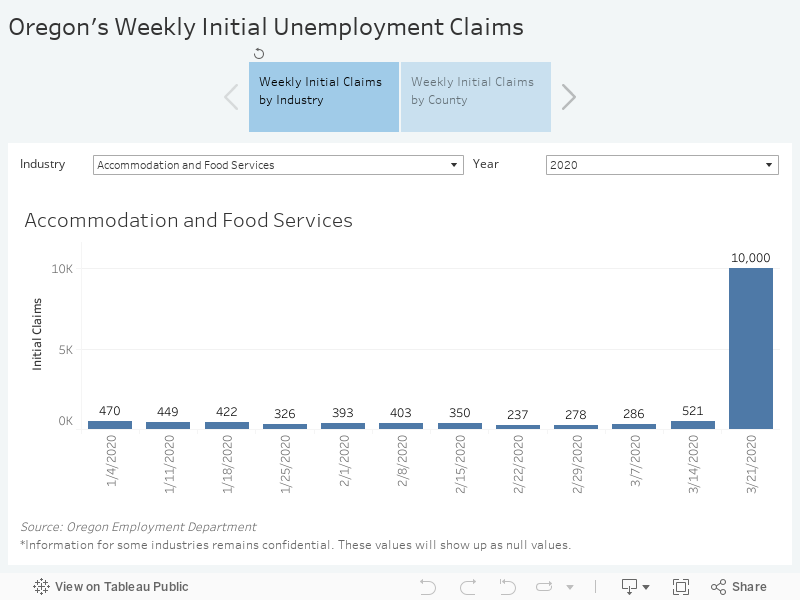
During the week of March 15, the Oregon Employment Department received more than 76,500 initial claims for Unemployment Insurance benefits. During the first three days of the week of March 22, initial claims have been tracking at record levels again. This comes as a sharp increase from 4,900 initial claims filed during the week of March 8. The Employment Department is taking several measures to meet the unprecedented need for unemployment benefits, which is largely due to reduced hours and layoffs related to the COVID-19 coronavirus pandemic. 

Initial Claims 
Of the 76,500 initial claims filed, the Employment Department has detailed information for the 22,800 claims processed during the week. The leisure and hospitality sector, which includes hotels and restaurants, saw the greatest number of initial claims for unemployment benefits (10,700). This reflects some of the early impact of public health and safety measures. Many initial claims also came from workers in health care (2,100) and retail trade (1,400). 

Multnomah, Washington, and Lane counties had the largest number of processed claims during the week of March 15. The largest increases in initial claims occurred in Union and Clatsop counties. More initial claims data by industry and area can be found on the QualityInfo.org COVID-19 page.

Note: Data in chart reflects the number of processed unemployment insurance claims. Not all processed claims have been classified by industry.

Helping Oregonians 
The Employment Department has been proactive in its response to an abrupt disruption in the economy by enhancing the performance and stability of our online claims system. Over the past two weeks, the agency also hired new employees, shifted existing staff working in other program areas, and trained them, doubling the number of employees working on unemployment claims. We will continue adding and training employees to process unemployment claims in the coming weeks. 

Still, record levels of unemployment claims cause longer wait times, as the department works to gather and process the details factoring into each individual claimant’s eligibility and weekly benefit amount. We encourage Oregonians who have lost their jobs to file claims using our online system to lower wait times by phone. A new video from the Employment Department shows step-by-step details for filing an online claim. 

The department also continues to offer job seeker and employer services, including more phone and virtual options for appropriate social distancing. We are present to help Oregonians who have experienced tremendous disruptions, while also doing our part to follow health and safety guidelines for our communities. 

The Employment Department’s COVID-19 web page serves as a resource guide. It includes an overview of the Unemployment Insurance program, along with questions and answers about specific COVID-19 coronavirus-related situations and unemployment benefits. We continue to update our site with the latest information related to COVID-19 as new federal and state guidelines change or expand benefits. The Employment Department has also enacted temporary rules, adding more flexibility for unemployment benefits to help Oregonians affected by COVID-19 business closures. 

To file an online claim for unemployment benefits, go to Oregon.gov/employ or call 1-877-FILE-4-UI. For help finding jobs and training resources, contact your local WorkSource Oregon center or go to WorkSourceOregon.org. Equal Opportunity program — auxiliary aids and services available upon request to individuals with disabilities. Contact: (503) 947-1794. For people who are deaf or hard of hearing, call 711 Telecommunications Relay Services.

Read the full, original press release here.